Start jumping rope after 50 with a Day 1 that matches your current ability, simple form cues, and a beginner approach that lets skill and fitness improve together.
When I started jumping rope in 2021, I was terrible.
I wasn’t returning to a skill from childhood. Aside from playing around with a clothesline when I was a kid, I had never really jumped rope. I was a complete beginner.
At first, I could hardly jump for more than 10 or 15 seconds without getting out of breath. I turned the rope too slowly, so I had to jump higher to give it time to pass under my feet. I knew one move, regular bounce. My timing was bad, and I tripped constantly.
When I tried Jump Rope Dudes workouts, I stopped before they stopped. I took extra breaks, paused the video, and sometimes quit early because I was gassed.
None of that meant jump rope wasn’t for me. I was learning a new skill while getting back into shape.
I watched Dan and Brandon’s coaching, worked on my form, and kept putting in reps. Gradually, I learned to turn the rope faster with less wasted movement, jump lower, use boxer skip, and complete more of the workouts with fewer breaks.
Jump rope eventually became the center of my training. I’ve since created and led hundreds of Gen X Jumps workouts, plans, and programs for adults 50+. That didn’t happen because I was naturally good at jumping rope. It happened because I stayed with the awkward beginner reps long enough to improve.
As my skill improved, so did the workout I could get from the rope. That is the lesson this training brief is built around: skill and fitness grow together.
Expect It to Be Ugly at First
A beginner’s early rounds rarely look like much of a workout.
The rope catches a foot. Your hands drift. The rhythm disappears. You get five turns, trip, reset, and get three more. You may spend as much time restarting as jumping.
That isn’t failure. That’s practice.
Jump rope asks you to coordinate your hands, the rope, and your feet while your breathing gets harder. Expecting all of that to look smooth on Day 1 makes no sense.
Your first job is simply to begin collecting successful reps. Every trip, reset, and clean jump is part of learning the skill.
Give Yourself a Fair Place to Learn
You don’t need a perfect gym. You need enough room, a usable rope, and a surface that isn’t working against you.
Choose a flat, clear area where your feet won’t slide.
Give the rope room above, behind, and beside you.
Wear athletic shoes that fit securely and feel stable when you bounce.
Use a rubber gym floor or jump-rope mat if one is available. Concrete and asphalt wear ropes out faster.
Start with the rope manufacturer’s sizing guide.
Before starting, spend a few minutes getting warm and moving the parts of your body you’re about to use. I usually march or run in place, move my shoulders, wrists, and ankles, warm up my calves and shins, and add a few easy hops if they feel comfortable.
The exact warm-up isn’t sacred. Its job is to let your body ease into the work and give you a chance to notice how you feel before the jumping gets harder.
Jump rope can become vigorous quickly. If you’ve been inactive, have a medical condition, or have symptoms that make you question whether vigorous exercise is appropriate, get guidance from a healthcare professional who knows your history.
Pick the Day 1 That Fits You
I don’t think every beginner should get the same first workout. The better question is: what can you actually do today?
If you have never successfully jumped rope:
Make Day 1 skill practice. Get one clean revolution and jump. Then try for two. Then five. Then ten. Take breaks whenever you need them and keep collecting clean reps instead of forcing a long set before the timing is there.
That practice can become a workout all by itself. When you’re new, learning the skill while repeatedly resetting and trying again can get you breathing hard pretty quickly.
If you can already jump:
Jump: 15 seconds
Rest: 20 seconds
Rounds: 5
Break: 1 minute after the five rounds
Then: Repeat the circuit only if you still feel good
The purpose is to find a starting point. You’re learning what happens to your breathing, coordination, timing, and body when you repeat the work. Day 1 is not a max-out test.
If you’re not ready to leave the ground:
You can still start. Use ropeless attachments if you have them, or practice the same rhythm without a rope passing under your feet. March, step side to side, shift your weight boxer-style, or make small controlled weight shifts while your hands turn as though you’re jumping.
Ropeless work can include jumping or no-jump movement. The point is to give you a version you can actually do now and build from there.
Think Like a Human Spring
You don’t need 14 form cues running through your head while the rope is moving. Start with four:
Stay tall and relaxed. Keep your head and neck comfortable. Extra tension makes the movement harder than it needs to be.
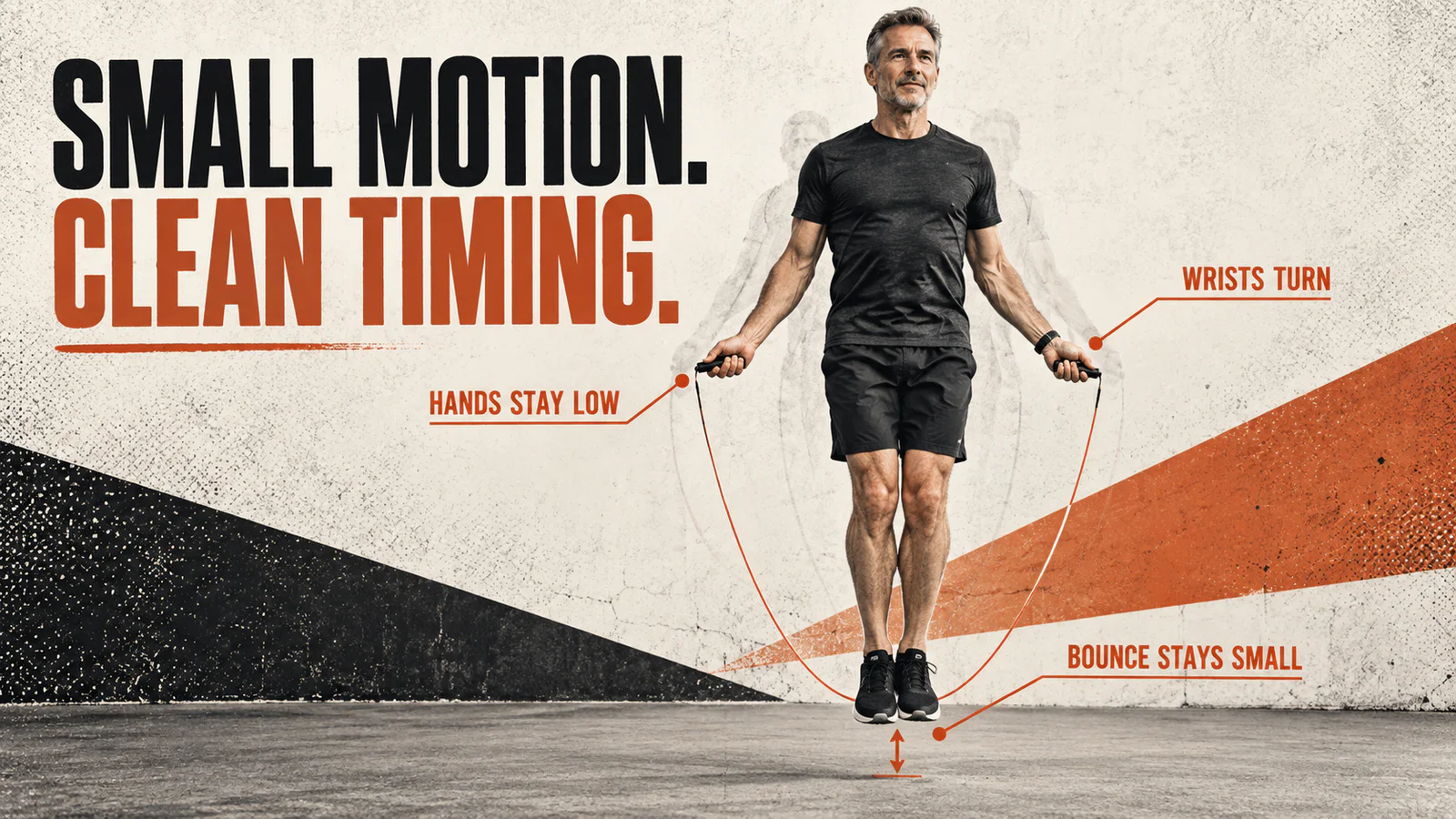
Keep your elbows near your sides. Let your hands sit around hip height instead of reaching far forward or drifting wide.
Turn the rope with your hands and wrists. Beginners often use big shoulder circles. Make the movement smaller and let the rope keep moving.
Jump low and land lightly. Leave only enough room for the rope to pass under your feet. Keep your knees soft instead of landing with stiff legs.
Think of yourself as a human spring. Your ankles, knees, and hips absorb the landing and send you back up. You don’t need to become rigid. You need to use less wasted movement.
When You Keep Tripping, Check One Thing at a Time
Repeated trips are frustrating. They aren’t proof that you’re incapable of learning.
Start with the most likely causes:
Rope length: A short rope may catch your toes or force your hands up. A long rope may hit the floor too far in front of you and bounce into your feet.
Hand position: Check whether one hand is higher, wider, or farther forward than the other.
Arm movement: Bring your elbows in and reduce large circles from the shoulders.
Timing: Practice one jump at a time or use ghost/ropeless work until the rhythm begins to feel more natural.
Rope feedback: An extremely light speed rope can be hard to feel when you’re learning.
Don’t change everything during the same round. Pick one likely cause, make one adjustment, and give it a few tries. Sometimes the setup is wrong. Sometimes you’re tripping because you’re new. Both problems can improve.
You don’t need an expensive rope to earn the right to begin. Any correctly sized rope that turns smoothly can teach you. I prefer Crossrope because the weight in the cable helps me feel where the rope is, which makes practice less frustrating and the workouts more engaging for me. Better equipment can give you clearer feedback. It can’t replace practice.
I have an affiliate relationship with Crossrope and may earn a commission from qualifying purchases. I recommend the ropes because I use them and prefer them for my own training.
Learn the Rhythm. Then Start Training.
At some point the rope starts making more sense. You begin to feel its pull and momentum instead of thinking about every single revolution. You find a natural pace. Your hands, feet, rope, and jump timing begin working together.
That’s the bridge from practicing jump rope to training with it. When you can go round after round with regular bounce and recover well enough to come back for another decent round, you’re ready to start using the rope as a real conditioning tool.
From there, keep the moves simple. Regular bounce comes first. Boxer step gives you another way to distribute the work. Run in place is an easy next move when you want more intensity without needing fancy footwork.
Don’t decide in advance that you must jump three days, five days, or every other day. Do a session, see how your body responds, and let recovery help set the frequency. If you feel good, you may be ready to jump again. If fatigue or soreness is accumulating, take the day off and reassess.
Earn more frequency by recovering well from the frequency you’re already doing.
What the Evidence Supports
The evidence supports starting slowly and building as your ability improves. It doesn’t give us one perfect jump-rope formula for every adult over 50.
Federal guidance encourages inactive older adults to begin with what they can do and gradually add more. The CDC lists jump rope as vigorous activity while also recognizing that the same activity can feel very different depending on the person. One small study found lower landing forces during basic rope skipping than running under the conditions tested, but the participants were 22 healthy women ages 18 to 25. That doesn’t prove jump rope is right for every adult over 50 or every painful joint.
Stop jumping and get qualified guidance for sharp or worsening pain, noticeable swelling, a joint that catches, locks, or feels unstable, a change in the way you walk, or symptoms that don’t settle. Those signs need more than a form cue from the internet.
We’re Not Here to Learn Tricks. We’re Here to Get Fit.
You don’t need double unders, criss-crosses, or a collection of impressive tricks to get a demanding jump-rope workout.
Restart: Complete a manageable first session, even if that means practicing one clean jump at a time, using ropeless movement, or stopping early.
Rebuild: Collect reps. Improve your timing. Reduce wasted movement. Gradually complete more work.
Stay Capable: Play the long game. Be patient enough to let the skill and your fitness grow together.
Simple doesn’t mean easy. As you improve, the same rope gives you more ways to work hard.
Your First Week
Put Jump Rope Into a Plan That Fits You
If you want a clear Day 1 and a full week built around it, the free personalized 7-Day Plan starts with your current activity, available days, equipment, and anything that may affect your training.
It gives you a workout schedule, ways to make the workouts easier or harder, cardio and recovery guidance, and a daily protein target. A rope is optional, so the plan can still meet you where you are if jumping isn’t the right starting point yet.
I still trip. Some days I trip more than usual and have to check my hands, timing, or rope.
The difference is that I no longer treat one rough round as proof that I’ve lost the ability to jump. A trip gives me information. I check one thing, reset, and keep going.
That is harder to remember when you’re new because every mistake can feel like evidence that you aren’t getting it. It isn’t. Learning isn’t a clean climb from bad to good. You may have a solid round, struggle through the next three, then suddenly find the rhythm again.
Check the obvious problems. Make an adjustment when one is needed. But don’t keep changing the rope, shoes, floor, and form because you think every trip must have a different cause. Beginner reps still look like beginner reps.
Don’t let frustration decide that jump rope isn’t for you. Give yourself enough reps to find out.
Todd Jones is the founder of Gen X Jumps. He began learning jump rope as a complete beginner in 2021 and now uses it as the center of his own training. He has created and led hundreds of workouts, plans, and programs for adults 50+ who want to rebuild fitness and stay capable.