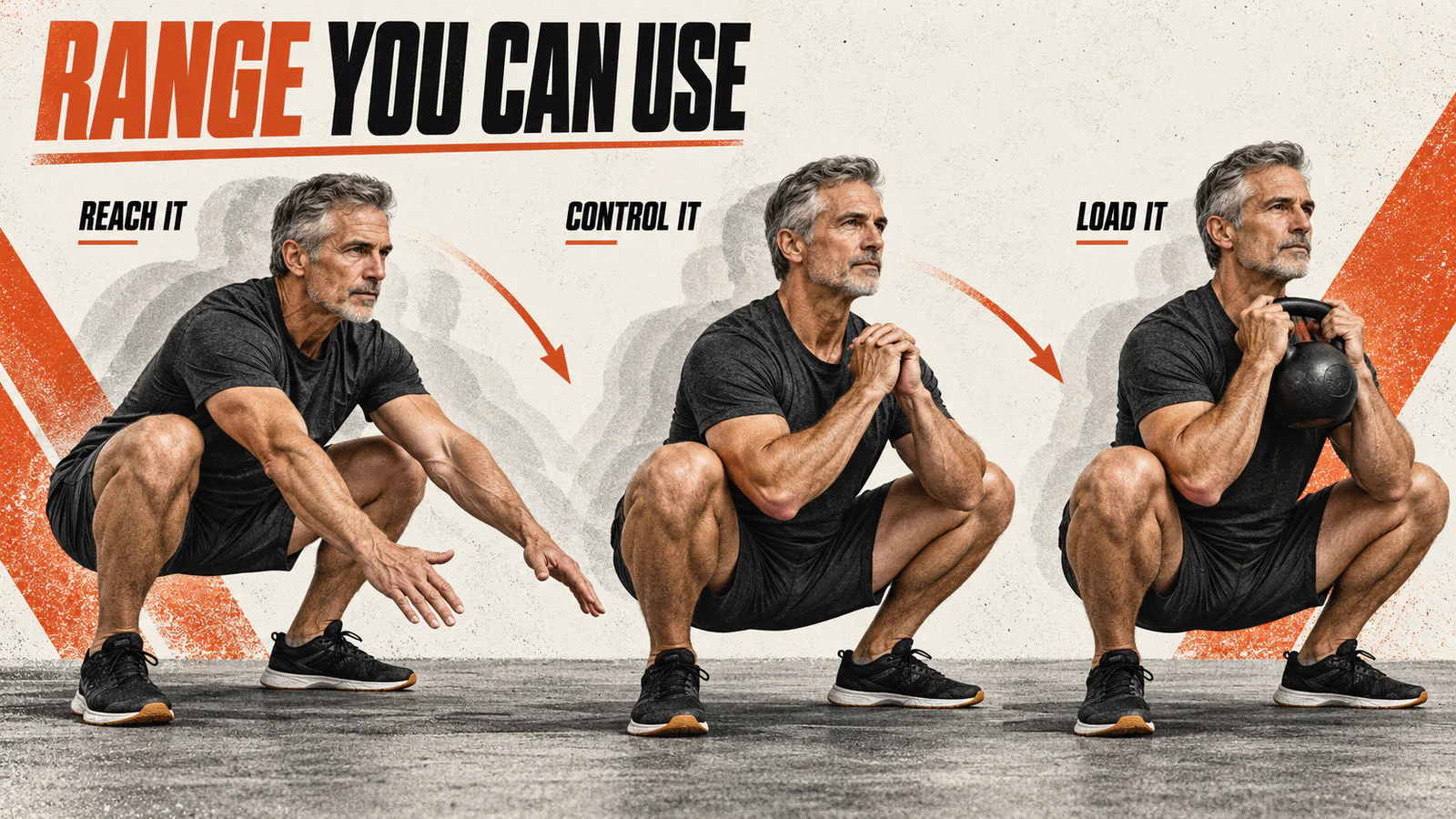
Mobility is your ability to use your body through the movements your life requires.
It takes enough range, strength, balance, and control to walk, climb stairs, get down to the floor and back up, reach overhead, ride a bike, and train.
You don’t need maximum flexibility or a complicated daily routine.
Keep practicing the movements you don’t want to lose.
Build strength through a comfortable range you can control.
If a specific movement becomes limited, give that problem focused attention instead of collecting random stretches.
I Know What It Feels Like When Movement Gets Taken Away
When my back acts up, almost every movement becomes harder. Walking, standing, bending, lifting, and even getting comfortable can turn into a problem because the muscles through your middle help steady so much of what you do.
Shoulder and elbow tendonitis have affected both my training and ordinary tasks. Reaching, pushing, pulling, and carrying don’t care whether the problem began in a gym. You feel it everywhere.
I’ve also had a knee problem so severe that I couldn’t walk. That made the loss of mobility impossible to ignore.
Those experiences changed what mobility means to me. I don’t think first about impressive stretches. I think about being able to use my body without every ordinary movement becoming a negotiation.
I haven’t built my training around a separate mobility routine. Most of my mobility work has come through warm-ups, strength training, bodyweight exercises, and staying active. So this isn’t a universal routine. It’s a practical guide to protecting useful movement, noticing where you’re limited, and knowing when the problem needs more than another stretch.
Mobility Is What Your Movement Lets You Do
I once had to look up the difference between mobility and flexibility because I was curious myself.
The practical distinction I use is simple:
Flexibility is how far a muscle or joint can move.
Mobility is your ability to use that movement with control.
The terms can overlap, but the distinction explains why exceptional flexibility isn’t my goal. I care about what my body can do.
Walking, stairs, floor movement, overhead reach, and biking require more than range alone. They use strength, balance, coordination, and control too. If I can still do those things at 70 and beyond, I’ll consider that a success even if I can’t fold myself into every yoga position.
I don’t need to become the most flexible man my age in Ohio. I want my body to keep doing its job.
Start With the Abilities You Want to Keep
Strength and mobility aren’t separate worlds.
A squat asks your hips, knees, and ankles to move while your legs and middle control the position. Step-ups practice much of what you need to climb stairs. Push-ups, rows, presses, carries, and floor exercises all build strength while your body moves through a useful range.
That doesn’t make every strength workout a complete mobility program. It does mean regular bodyweight or weighted training can help protect many of the movements you want to keep.
Getting off the floor is a good example. Flexibility may be part of it, but so are leg strength, strength through your middle, balance, and coordination. Stretching one muscle won’t replace the rest of the job.
A useful question is, “What do I want my body to keep doing?” Then keep practicing those abilities and building the strength they require. If getting off the floor matters, practice getting down and back up with support when you need it. If stairs matter, keep climbing stairs or use step-ups you can control. The goal is to keep the movement part of your life instead of waiting to discover you’ve lost it.
A Warm-Up and a Mobility Practice Have Different Jobs
My jump-rope warm-up is short and specific. I march in place, run in place, do jumping jacks, use a lunge-and-rotation movement often called the world’s greatest stretch, then move through calf and shin stretches, ankle rolls, wrist and forearm movements, and shoulder circles.
That prepares the areas I’m about to use and gives me an early read on how the body feels.
For much of my lifting, I’ve gone straight to the weight I planned to use for the workout. I’m not offering that as a recommendation. It’s simply what I’ve often done. A lighter first set lets you practice the movement and see how your body responds before the exercise gets harder.
A warm-up prepares you for the workout in front of you. Dedicated mobility work has a longer job. It targets a range or movement you want to improve or maintain over time.
Most of my mobility work has come through warm-ups, strength training, and bodyweight movement rather than separate sessions. That may be enough for many movements while they still feel good. A specific restriction may need its own practice, a change in how you train, or help identifying what is actually limiting you.
Give Focused Attention to an Actual Limitation
You don’t need to collect stretches because the internet says every adult over 50 needs the same ten-minute routine.
Start with the movement you want or need:
What am I trying to do?
What appears to be limiting it: stiffness, weakness, pain, balance, or control?
Can my regular training maintain or improve it?
Does it need specific practice or help from a qualified professional?
If reaching overhead is restricted, that gives you a specific problem to investigate. If you can’t get comfortably to the floor, look at the pieces of that task. Is it range, strength, balance, pain, or fear of getting stuck? If you can already walk, squat, reach, ride, and train without restriction, you may not need to chase more range just to win a flexibility contest.
More range isn’t automatically better in every joint. Useful range is the amount you can control for the life and activities you want.
Pain Changes the Question
Limited movement isn’t always a stretching problem. Sometimes pain is the thing stopping you.
A familiar ache may lead you to use less weight, choose an easier version of the exercise, or wait until the area settles. A major change in pain or function is different.
One knee problem was unmistakably beyond my familiar aches. The joint looked and felt out of alignment, the pain and swelling were extreme, and I couldn’t walk. That wasn’t something to stretch or train around. It needed medical attention.
General mobility advice can’t diagnose why a joint is restricted or determine whether an injured area is safe to stretch or exercise. New or severe pain, major swelling, a joint that appears out of alignment, an inability to put weight on it or move normally, locking, giving way, unexplained weakness, numbness, or symptoms that keep worsening deserve attention from a qualified healthcare professional.
You don’t need to panic over every ordinary ache. You also don’t need to prove your toughness by treating every problem like one more stretch will fix it.
What the Evidence Supports
The National Institute on Aging reports that physical activity can improve physical function and make daily tasks easier for older adults. It also recommends a mix of aerobic, muscle-strengthening, and balance activity. A systematic review found that yoga produced small improvements in balance and moderate improvements in physical mobility among adults 60 and older, although programs and participants varied.
Those sources support staying active and deliberately practicing useful physical abilities. They don’t identify one mobility routine every person needs or diagnose the cause of a limitation.
Keep Practicing What You Don’t Want to Lose
Mobility doesn’t need to become a complicated separate system.
Restart: Begin with the movement you can control. Don’t force your body to prove it still owns a range it hasn’t used in years.
Rebuild: Use strength, bodyweight movement, warm-ups, balance work, and focused mobility where you actually need them.
Stay capable: Keep walking, climbing, reaching, getting down, getting back up, and training.
You don’t need perfect mobility. You need enough useful movement for the life you want to keep living.
Your Next Seven Days
Build a Week Around What You Can Do Now
The free personalized 7-Day Plan uses your current activity, available days, equipment, and physical considerations to build your workout week. It includes strength work, options that fit your current ability, cardio and recovery direction, and a daily protein target.
The most efficient mobility checklist isn’t automatically the one you’ll keep doing. Sometimes the experience is what brings you back.
The one dedicated movement practice I truly loved was yoga. I used to go once a week with my daughter.
Yes, it challenged mobility, flexibility, balance, strength, and control. But reducing yoga to its physical benefits misses why it was outstanding.
Yoga was mindset. It was internal, personal, and meditative. The class moved from active work into slower, restful work that let me turn inward and quiet everything down.
The studio was part of it too. I liked leaving home, finding a place in the room, being around other people, and receiving live guidance. I remember the heat, the music, the floor, the smell, and the whole atmosphere.
Doing yoga alone in front of a screen sounds boring to me because it would remove most of what made the experience special. I didn’t stop because yoga failed to help or because I lost interest. I lost access to the version I loved.
I still miss it, and I’d gladly return to the right studio. Yoga gives me something a checklist of stretches never will.
Related Next Steps
Fitness - See how jump rope, strength, mobility, and recovery fit together.
Strength Training After 50 - Use simple bodyweight or weighted training to build strength and stay capable.
Todd Jones is the founder of Gen X Jumps. He shares the workouts, habits, and lessons he uses to lose fat, build muscle, and stay capable. His mobility perspective comes from training, adapting around recurring trouble spots, and paying attention to what ordinary movement makes possible.